

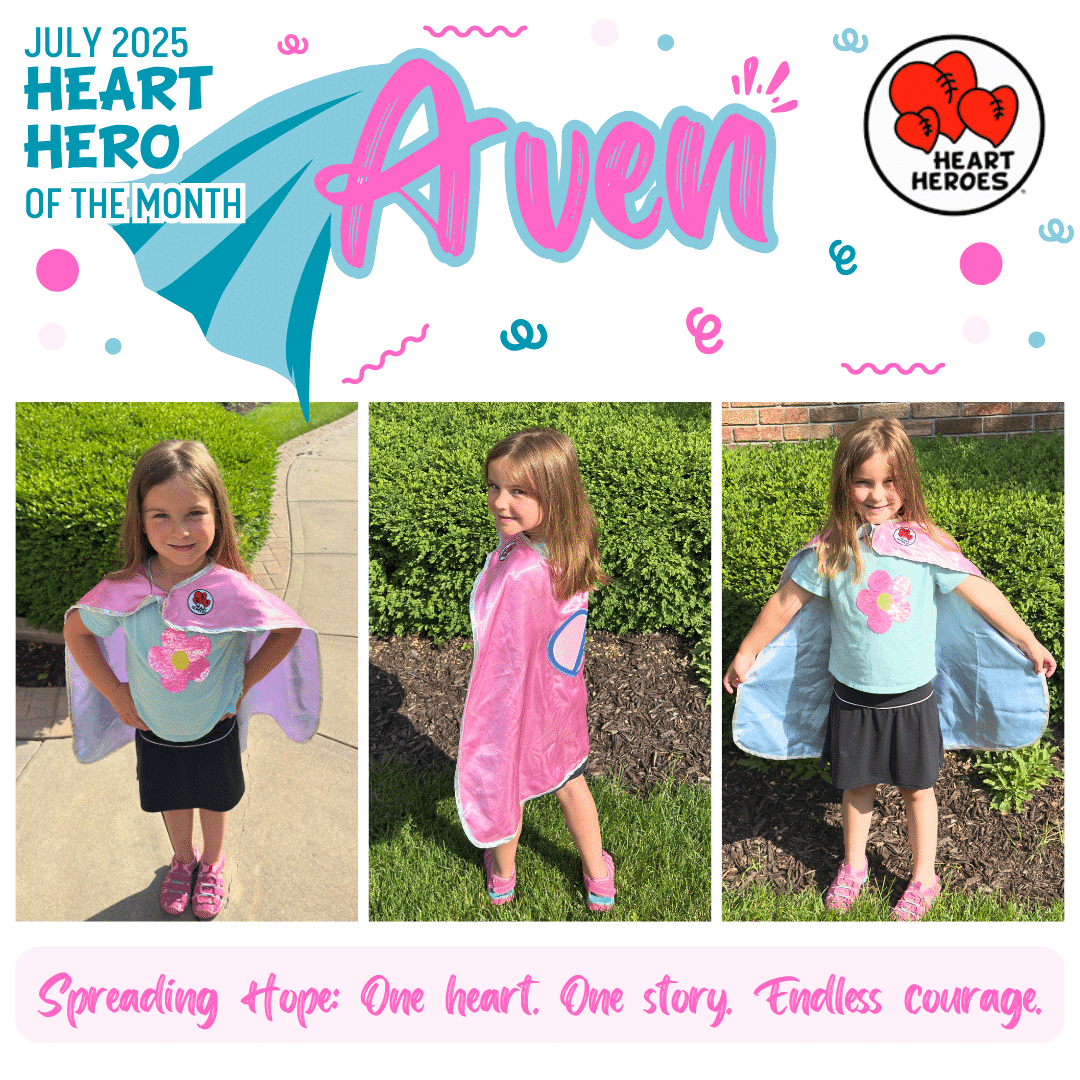
Spreading Hope: One heart. One story. Endless courage.
Written by ♥️Dad, Tony
Our daughter Aven was diagnosed with a congenital heart defect called Tetralogy of Fallot during my wife’s 20-week anatomy scan. It’s a condition made up of several serious heart issues, including:
- A ventricular septal defect—a large hole between the two lower chambers of her heart
- Pulmonary valve stenosis—a narrowing of the artery carrying blood from her heart to her lungs
- A bicuspid pulmonary valve—her valve has only two leaflets instead of the usual three, and is smaller than normal
- Right ventricular hypertrophy—the right side of her heart is overworked and thickened due to the effort of pumping mixed blood
- And a misaligned aorta, which further complicates the way blood flows through her heart
Finding out during the pregnancy gave us time to prepare. We did our research, met with other parents who had been through similar journeys, and worked closely with doctors and specialists. That preparation was a gift, but it didn’t take away the fear. The weeks that followed were filled with anxiety and uncertainty. It’s a strange and helpless feeling when you want nothing more than to protect your child—but there’s absolutely nothing you can do except wait.
Aven was born on April 24th, 2019, at Women’s Hospital in Omaha. The delivery room was filled with incredible doctors and nurses, ready for whatever would come next. One of our biggest fears was that she might be what’s called a “Blue Tet,” meaning her body wouldn’t get enough oxygen and she’d need immediate surgery. But Aven arrived as a “Pink Tet”—her oxygen levels were low, but stable enough that surgery could wait. It was a huge relief.
She spent her first night in the NICU under close monitoring. While the team there was outstanding, being in that space instead of a traditional recovery room was emotionally overwhelming. When we were finally able to take her home, we were given a new list of things to watch for—heavy breathing, sweating, low oxygen levels—any of which might mean her heart was no longer keeping up.
By mid-August, we noticed she was sleeping more than usual—what we first thought was great napping turned out to be a warning sign. Her skin began to take on a grey tint. We contacted her cardiology team immediately. It was clear: it was time for surgery.
Preparing for Aven’s surgery was an emotional rollercoaster. My constant thought was, how can I stay steady enough to be what she needs? My biggest fear was handing her off to the surgical team and never getting her back. It’s terrifying to hear that your baby’s heart will be placed on bypass. But the team at Children’s Hospital is truly the best of the best. They were real, professional, compassionate—and they gave us confidence that everything would be okay.
The day before surgery, we spent several hours at Children’s doing pre-op bloodwork, a full physical, and paperwork. We met with her anesthesiologist, Dr. Kerrie George, and her surgeon, Dr. James Hammel. I asked Dr. Hammel what the best-case scenario looked like—something to focus on, to hope for. He was thoughtful, passionate, and thorough with every answer. We later learned he’s one of the top surgeons in the country for this procedure. Aven was in good hands.
Surgery Day.
We arrived at 5:30 a.m. for her 7:00 a.m. operation. We stayed with her right up until 6:50 a.m., when Dr. George came to take her back for surgery prep. That morning, Aven was especially sweet—calm, smiling. It scared me a little, but looking back, it was almost like she was telling us, “Don’t worry, I’ve got this.”
I had to step out of the room for air—hospitals have never been easy for me—and that’s when I ran into a family friend, Dr. Pietro. I’ve always said, “If you’re having a rough day, find Dr. Pietro—he’ll give you a bear hug that’ll fix anything.” He’s a dentist and just happened to be there that morning for a separate procedure. The second I saw him, I broke down. And when he gave me that hug, I realized—he wasn’t just there for work. He was there for us.
That moment gave me peace. It was time to trust the process.
While Aven was in surgery, my wife and I were placed in a private waiting room. I worried about letting my mind drift to dark places, but Children’s kept us grounded by calling every 15 to 30 minutes with updates. When we got the call that Aven’s heart was off bypass and beating on its own, it was an overwhelming relief.
She was moved to the PICU for recovery, and that’s when we were finally able to see her. Nothing prepares you for the moment you see your child surrounded by wires and machines. All you want is to hold them, to make it better. The nurses were phenomenal—kind, patient, and understanding—and they allowed us to hold her while she slept, even in those fragile early hours.
Night 1 was tough. Aven was restless, and the nurses came in often to check on her. She wanted to be held, but holding her clearly caused discomfort. Her throat was sore from the breathing tube, and she kept coughing up phlegm, which only made it worse. But each night after that got a little easier—for her, and for us.
Day 2, she was allowed two ounces of Pedialyte, and later that day, she took some milk. We were able to hold her more, and though it was still hard for her to get comfortable, she did sleep a nice stretch in my arms. Around 4 p.m., she was moved up to the fifth floor to continue her recovery.
Night 2, she had an early X-ray and EKG, which made it hard for her to settle, and sleep was tough to come by.
Day 3 brought major progress. The doctors removed her chest tubes and pacing wires—both of which had been making her very uncomfortable. Once they were out, she was visibly more content. We hadn’t been giving her any oxycodone, but gave her one small dose before her echocardiogram that day. She was constipated (as often happens post-op), so the nurses administered a suppository. We also learned how to safely lift and hold her while her chest healed. She even got a bath that day—and a few smiles. She was beginning to look like herself again. That night, we put her in jammies for the first time.
Day 4, we were discharged and headed home by 3 p.m.
Post-Surgery:
Aven went home after just four days in the hospital. She was on Tylenol, Lasix, and a stool softener, though giving her medicine was a challenge—she hated it! So, we mixed it with a couple ounces of milk to make sure she got it down, then followed with the rest of her bottle.
Today, Aven is thriving. Unless you saw the one-inch scar on her chest, you’d never know she had open heart surgery—or that she has a heart condition at all. Every symptom she had before surgery is completely gone. She’s hitting all her developmental milestones (a few were a little delayed due to the timing of her surgery), and she’s a bright, happy, sweet child.
Going through this experience changed us. It opened our eyes and shifted our perspective on what really matters. There are some moments in life you simply can’t plan for—but they happen for a reason. For families walking a similar path, my wife and I try to share not just the facts, but the emotions and mindset that helped carry us through.
We hope Aven’s story offers comfort, courage, and a little bit of light to those still in the thick of it. You’re not alone. And there is so much hope.
One Comment
Mel
Yes, Aven!!!!! Tony, thanks for sharing ❤️